Menu

View categories

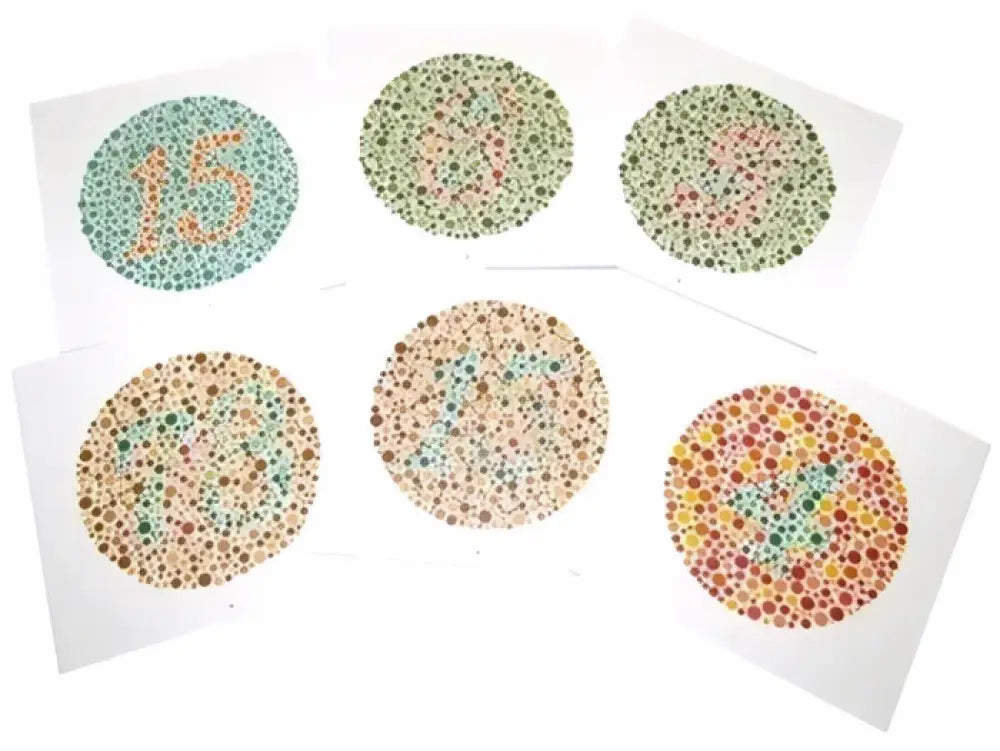
Single plates (11.5x11 cm) packed in a practical cardboard box (13.5x11.5x2.3 cm). Multilingual box and instructions: GB, FR, IT, ES, PT, DE, PL, RO, LT, SK, Arabic.
No. 1. Any subject, whether normal or deficient in color vision, will read the numbers "15" correctly.
This plate is mainly used for preliminary explanation of the test process to the subjects.
No. 2. Normal subjects will read "6" and those with red-green deficiencies can only see a dot inside "6".
No. 3. Normal subjects will read "5" and those with red-green deficiencies can only see a dot inside "5".
No. 4. Normal subjects will read "10" read and those with red-green deficiencies can only see #0.
#5. Normal subjects will read #23 and those with red-green deficiencies can only see #3.
#6. Normal subjects will read #62 and those with red-green deficiencies can only see #2.
#7. Normal subjects will read #31 and those with red-green deficiencies can only see #1.
#8. Normal subjects read #53 and those with red-green deficiencies can only see #3.
#9. Correctly decipherable by normal subjects, but illegible or difficult to read for those with red-green deficiencies.
# 10. Correctly decipherable by normal subjects, but illegible or difficult to read by those with red-green deficiencies.
No. 11. Correctly decipherable by normal subjects, but illegible or difficult to read by those with red-green deficiencies.
No. 12. Normal subjects and those with mild red-green deficiencies see the digits "51", but protanopia and strong protanomalia read only "1", and deuteranopia and strong deuteranomaly
only "5".
No. 13. Normal subjects and those with mild red-green deficiencies see the digits "36", but protanopia and strong protanomaly read only "6", and deuteranopia and strong deuteranomaly
only "3".
No. 14. When tracing the squiggly lines between the two X's, the normal line follows the purple and
red lines. In protanopia and strong protanomaly, only the purple line is traced, and in mild
protanomaly, both lines are traced, but the purple line is easier to follow. In deuteranopia and strong
deuteranomaly, only the red line is traced, and in mild deuteranomaly, both lines are traced,
but the red line is easier to follow.
No. 15. When tracing the squiggly line between the two X's, both normal subjects and subjects with color vision deficiencies can trace the line.
Art. no.
1308084
Availability
Shipping
Ordered before 3:00 PM on weekdays and the entire order in stock: shipped the same day.
Single plates (11.5x11 cm) packed in a practical cardboard box (13.5x11.5x2.3 cm). Multilingual box and instructions: GB, FR, IT, ES, PT, DE, PL, RO, LT, SK, Arabic.
No. 1. Any subject, whether normal or deficient in color vision, will read the numbers "15" correctly.
This plate is mainly used for preliminary explanation of the test process to the subjects.
No. 2. Normal subjects will read "6" and those with red-green deficiencies can only see a dot inside "6".
No. 3. Normal subjects will read "5" and those with red-green deficiencies can only see a dot inside "5".
No. 4. Normal subjects will read "10" read and those with red-green deficiencies can only see #0.
#5. Normal subjects will read #23 and those with red-green deficiencies can only see #3.
#6. Normal subjects will read #62 and those with red-green deficiencies can only see #2.
#7. Normal subjects will read #31 and those with red-green deficiencies can only see #1.
#8. Normal subjects read #53 and those with red-green deficiencies can only see #3.
#9. Correctly decipherable by normal subjects, but illegible or difficult to read for those with red-green deficiencies.
# 10. Correctly decipherable by normal subjects, but illegible or difficult to read by those with red-green deficiencies.
No. 11. Correctly decipherable by normal subjects, but illegible or difficult to read by those with red-green deficiencies.
No. 12. Normal subjects and those with mild red-green deficiencies see the digits "51", but protanopia and strong protanomalia read only "1", and deuteranopia and strong deuteranomaly
only "5".
No. 13. Normal subjects and those with mild red-green deficiencies see the digits "36", but protanopia and strong protanomaly read only "6", and deuteranopia and strong deuteranomaly
only "3".
No. 14. When tracing the squiggly lines between the two X's, the normal line follows the purple and
red lines. In protanopia and strong protanomaly, only the purple line is traced, and in mild
protanomaly, both lines are traced, but the purple line is easier to follow. In deuteranopia and strong
deuteranomaly, only the red line is traced, and in mild deuteranomaly, both lines are traced,
but the red line is easier to follow.
No. 15. When tracing the squiggly line between the two X's, both normal subjects and subjects with color vision deficiencies can trace the line.

Free shipping from €100 excl. VAT and €121 incl. VAT (NL)
On weekdays before 3 PM and in stock, shipped same day
For both professionals and consumers
For Praktijk Plus customers, discounts up to 25%*
Your practice in NL can order on account